maandag 14 februari 2011

Hussein Chalayan

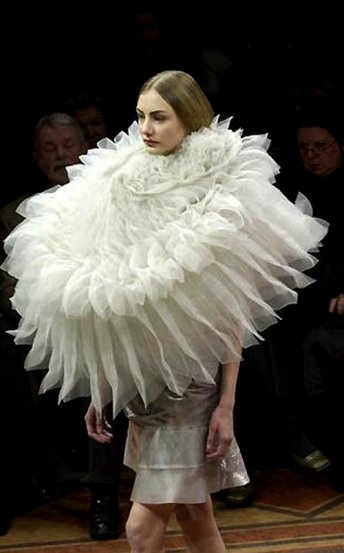
A wooden tiered skirt that turns into a fabulous side table; a pair of puffy, helium-filled black balloons floating above a model and attached to her via a black jumper/harness combination that she might have just parachuted into; a dress that transforms at the touch of a button from a shiny, slim shealth to what could pass for a high-tech version of the panniers that supported the voluminous skirts of 18th Century fashionistas like Marie Antoinette...let's just say that Hussein Chalayan has always been a designer less interested in financial concerns than in really interesting ideas about fashion.

To pay the bills, the avant garde designer works at Puma as their Creative Director; however, his passions run in a decidedly less commercial direction, and London's Design Museum is about to honor him with Hussein Chalayan - From Fashion and Back, covering the last 15 years and featuring 35 of his more out-there creations which variously reference architecture, technology, anthropology, and philosophy.

"I'm too young for a retrospective," the designer recently insisted to WWD."I mean, I'm only 38 years old. "It's more like an art show — with clothes. You're not going to see any coats — nothing commercial. These are my clothes in their purist form, the monumental pieces...I want the audience to see that a lot of things in life are interrelated. I love all the connections in the world. We’re brought up to think we're isolated — an idea that’s a bit dull, and just not true."

"Hussein is someone who looks at fashion from a technological level," observes Jochen Zeitz, chairman and CEO of Puma which is the main sponsor of the retrospective. "The exhibition will be very interesting for designers — not just fashion designers, but people who are interested in technology. He has a technological mind, but knows how to translate technological information into designing fashion."

However, this being Chalayan's take on the world, even the settings will be unusual with display mannequins painting, cleaning windows, watering olive trees, and even taking a coffee break.


Textiel

Het is zacht en flexibel. Het voegt zich. Het is het eerste materiaal dat je om je heen gewikkeld krijgt als je op de wereld gezet wordt. In de vorm van een luier of hempje Als kunstenaar kan ik ermee tekenen, vormen, scheuren, knopen, rollen, schilderen etc. Flexibilieit, even los van wat het in het leven moet betekenen voor mij, is een belangrijk aspect in mijn werk. Textiel is ruimtelijk van zichzelf. Ik eis dan ook van mezelf het ruimtelijke karakter te benutten. Het materiaal vraagt erom gezien te worden in al zijn facetten. Ik geef het die ruimte. (Lam de Wolf)

zondag 13 februari 2011

Gebruik van de ruimte

Inspiratie video pianotrap

Textiel

Het is zacht en flexibel. Het voegt zich. Het is het eerste materiaal dat je om je heen gewikkeld krijgt als je op de wereld gezet wordt. In de vorm van een luier of hempje Als kunstenaar kan ik ermee tekenen, vormen, scheuren, knopen, rollen, schilderen etc. Flexibilieit, even los van wat het in het leven moet betekenen voor mij, is een belangrijk aspect in mijn werk. Textiel is ruimtelijk van zichzelf. Ik eis dan ook van mezelf het ruimtelijke karakter te benutten. Het materiaal vraagt erom gezien te worden in al zijn facetten. Ik geef het die ruimte. (Lam de Wolf)

Wikipedia:

Textiel is letterlijk "al wat geweven is". Het woord is afgeleid van het Latijnse woord "texere" dat weven betekent.

In het moderne spraakgebruik wordt textiel veel ruimer gebruikt: textiel is een materiaal, dat bestaat uit filamenten (eindloze draden) of vezels (korte stukjes draad). Textiel is praktisch altijd vervormbaar en kan een, twee- of driedimensionaal zijn.

De samenhang in het textiele materiaal ontstaat door de grondstoffen te spinnen, twijnen (of kableren of slaan), weven, breien, knopen, vlechten of door er vilt (een soort harige vlies) van te vormen non woven (vliesvorming).

Na het spinnen is een eendimensionale textiel ontstaan: het garen. Ook getwijnde, gekableerde of geslagen textiel (twijn, touw of kabel) noemen we eendimensionaal omdat de dikte vergeleken met de lengte zeer klein is. Gebreide, geweven, gevlochten en geknoopte textiel gaat uit van garen en is meestal tweedimensionaal en in uitzonderingsgevallen driedimensionaal (afstandsweefsel of breisel, slangen, zakken, neuskegels van raketten). Gevlochten textiel is een- (koord), twee- (band) of driedimensioneel (omvlechtingen). Bij de vliesvorming is in tegenstelling tot de andere technieken niet altijd een garen nodig. Ook met losse vezels kan een textiel materiaal gevormd worden (o.a vilt). Vliezen zijn tweedimensionaal.

Van textiel worden onder andere kleding (waaronder bedrijfs- en beschermende kleding), huishoudtextiel, woningtextiel, technische textiel, geotextiel, rubberversterking en kunststofversterking gemaakt. Verder wordt textiel in allerlei hobby´s en in de kunst toegepast.

De ontwikkeling van spinnen en weven van katoen is vanaf 3400 v.Chr. in Egypte begonnen. Ook de zijdecultuur kan bogen op een lange geschiedenis, vanaf 2600 v.Chr. wordt in China zijde gesponnen en tot stoffen geweven. Er zijn bronnen die veronderstelling dat de textiel- en weefkunst al veel ouder is (20.000 v.Chr.), uit een van de belangrijkste vondsten van de laatste decennia, de ijsmummie Ötzi, blijkt in ieder geval dat hij in die tijd (3100 v Chr.) nog geen geweven textiel droeg.

Grondstoffen

De grondstof waaruit textiel gemaakt wordt zijn filamenten of vezels. Bij het benoemen van de grondstoffen spreekt men echter altijd van vezels en niet van filamenten.

De textiele grondstoffen kan men indelen in de volgende groepen:
-natuurlijke grondstoffen
vezels van plantaardige afkomst
vezels van dierlijke afkomst

-kunstmatige grondstoffen
vezels met een natuurlijke oorsprong
vezels met een synthetische oorsprong.


Verreweg de voornaamste plantaardige vezel is de katoen, gevolgd door linnen. Tegenwoordig worden in beperkte mate andere vezels zoals hennep,brandnetels, bamboe in kleding toegepast, terwijl verder nog voorkomen manilla, sisal, kokos enz.

De belangrijkste dierlijke vezel is wol en daarna zijde, angora, camel en diverse andere haarsoorten.

Eind negentiende eeuw zijn de eerste kunstmatige vezels gemaakt. Omdat de natuurlijke vezels bestaan uit lange moleculen, de macromoleculen, werd gezocht naar geschikte moleculen die uit goedkope natuurlijke grondstoffen gehaald konden worden. Hiervoor is het cellulose molecuul uit hout gebruikt. Hieruit is de eerste kunstmatige vezel op natuurlijke basis gemaakt: rayon.

In de twintigste eeuw werd gezocht naar synthetische macromoleculen waaruit vezels gemaakt konden worden. In 1938 werd de eerste geheel synthetische vezel ontdekt: Nylon, een polyamide vezel. Hierna worden nog zeer veel andere vezels ontwikkeld, zoals polyester, polyacryl, polyurethaan, polyetheen, polypropeen, aramide.
[bewerken] Technieken

De manieren om textiel te maken kunnen verdeeld worden in industriële en als hobby beoefende methodes.:

Industriële methodes

-Het maken van garen
vezelgarenspinnen
filamentgarenspinnen

-Het maken van doek
nonwovens
weven
breien
vlechten
knopen
tuften

Een aantal methodes, die als hobby uitgeoefend worden:

-Het maken van garen
spinnewiel
spintol

-Het maken van doek
haken
naaldbinden
punniken
knopen
macramé
kantklossen

Voordat textiel op de markt komt ondergaat het nog een of meer nabewerkingen. Deze zijn sterk afhankelijk van de toepassing. Enkele mogelijkheden zijn:

verven
bedrukken
nabehandelen om de eigenschappen te verbeteren
borduren
plooien of rimpelen
smocken
...

Textiel wordt niet alleen voor kleding gebruikt, maar ook in vele andere toepassingen zoals

-beschermende kleding zoals handschoenen tegen snijwonden, veiligheidskleding, kogelwerende vesten.
-huishoudelijke toepassingen, zoals in, poetslappen, dweilen, lakens, dekens, theedoeken, handdoeken, tafelkleden, zakdoeken.
-woningtextiel zoals vitrage, gordijnen, tapijt, vloerbedekking, zonneschermen.
-technische textiel zoals dekzeilen, tenten, parachutes, schermen, veiligheidsgordels, touwen.
-geotextiel zoals dijkbescherming, erosiebescherming, versteviging van de ondergrond onder wegen.
-rubberversterking zoals in fiets- en autobanden, transportbanden, slangen, rubberboten.
-kunststofversterking zoals versterking van polyester voor boten en auto´s en pantsering van auto´s.


Daarnaast is textielkunst een onderdeel van de beeldende kunst.

fast fashion

Fast fashion is a contemporary term used by fashion retailers to acknowledge that designs move from catwalk to store in the fastest time to capture current trends in the market.[1] This has developed from a product driven concept based on a manufacturing model referred to as "quick response" developed in the U.S. in the 1980s [2]and moved to a market based model of "fast fashion" in the late 1990s and first part of the 21st century. Zara have been at the forefront of this fashion retail revolution and their brand has almost become synonymous with the term but there were other retailers who worked with the concept before the label was applied such as Benetton. [3] [4] Fast fashion has also become associated with disposable fashion because it has delivered designer product to a mass market at relatively low prices.[5] Fast fashion is a term used to describe clothing collections which are based on the most recent fashion trends presented at Fashion Week in both the spring and the autumn of every year.[6] These trends are designed and manufactured quickly and cheaply to allow the mainstream consumer to take advantage of current clothing styles at a lower price. This philosophy of quick manufacturing at an affordable price is used in large retailers such as H&M, Zara, and Topshop. It particularly came to the fore during the vogue for "boho chic" in the middle of the first decade of the 21st century

Category Management

The primary objective of the fast fashion is to quickly produce a product in a cost efficient manner. This efficiency is achieved through the retailers’ understanding of the target market's wants, which is a high fashion looking garment at a price at the lower end of the clothing sector.[6] Primarily, the concept of category management has been used to align the retail buyer and the manufacturer in a more collaborative relationship.[8] Category management is defined as "the strategic management of product groups through trade partnerships, which aims to maximize sales and profits by satisfying customer needs"..[8] This collaboration occurs as many companies’ resources are pooled to increase the market's total profit. The fast fashion market utilizes this by uniting with foreign manufacturers to keep prices at a minimum.

Quick Response Method

Quick Response (QR) was developed to improve manufacturing processes in the textile industry with the aim of removing time from the production system.[9] The U.S. Apparel Manufacturing Association initiated the project in the early 1980s to address a competitive threat to its own textile manufactures from imported textiles in low labour cost countries.[10] During the project lead times in the manufacturing process were halved; the U.S. industry became more competitive for a time, and imports were lowered as a result. [11] The QR initiative was viewed by many as a protection mechanism for the American textile industry with the aim of improving manufacturing efficiencies.[12]

The concept of quick response (QR) is now used to support "fast fashion", creating new, fresh products while also drawing consumers back to the retail experience for consecutive visits.[13] Quick response also makes it possible for new technologies to increase production and efficiency.[13] The Spanish mega chain Zara has become the global model for how to decrease the time between design and production. This production short cut enables Zara to manufacture over 30,000 units of product every year to nearly 1,600 stores in 58 countries.[14] New items are delivered twice a week to the stores, reducing the time between initial sale and replenishment. As a result, the shortened time period improves consumer's garment choices and product availability. In the case of Renner, a Brazilian chain, a new mini-collection is released every two months.[14] New technologies are constantly being pioneered to accelerate quick response. Recently, the continuous inkjet printing process was introduced from the combined effort of Dutch printing company Osiris, and the French inkjet specialist Imaje.[15] The process uses image editing software to convert screen printing into continuous digital printing. The digital printing continuously recirculates the unused ink back into the system instead of the stop start method used by the traditional screen printing method.[15] As a result, the recirculation results in a reduction of preparation time and a reduction in ink costs because of fewer waste products.

Marketing

Marketing is the key driver of fast fashion. Marketing creates the desire for consumption of new designs as close as possible to the point of creation. This is achieved by promoting fashion consumption as something fast, low price and disposable. The fast fashion business model is based on reducing the time cycles from production to consumption such that consumers engage in more cycles in any time period. For example, the traditional fashion seasons followed the annual cycle of summer, autumn, winter and spring but in fast fashion cycles have compressed into shorter periods of 4-6 weeks and in some cases less than this. Marketers have thus created more buying seasons in the same time-space.[16] Two approaches are currently being used by companies as market strategies; the difference is the amount of financial capital spent on advertisements. While some companies invest in advertising, fast fashion mega firm Primark operates with no advertising. Primark instead invests in store layout, shopfit and visual merchandising to create an instant hook.[17] The instant hook creates an enjoyable shopping experience, resulting in the continuous return of customers. Research shows that seventy five percent of consumer's decisions are made in front of the fixture within three seconds.[8] The alternative spending of Primark also "allows the retailer to pass the benefits of a cost saving back to the consumer and maintain the company's price structure of producing garments at a lower cost".[8]

"Supermarket" Market

The consumer in the fast fashion market thrives on constant change and the frequent availability of new products.[13] Fast fashion is considered to be a "supermarket" segment within the larger sense of the fashion market.[8] This term refers to fast fashion's nature to "race to make apparel an even smarter and quicker cash generator".[13] Three crucial factors exist within fast fashion consumption: market timing, cost, and the buying cycle.[8] Timing's objective is to create the shortest production time possible. The quick turnover has increased the demand for the number of seasons presented in the stores. This demand also increases shipping and restocking time periods. Cost is still the consumer's primary buying decision. Costs are largely reduced by taking advantage of lower prices in markets in developing countries. In 2004 developing countries accounted for nearly seventy five percent of all clothing exports and the removal of several import quotas has allowed companies to take advantage of the even lower cost of resources.[13] The buying cycle is the final factor that affects the consumer. Traditionally, fashion buying cycles are based around long term forecasts that occur one year to six months before the season.[13] Yet, in the fast fashion market the quick response philosophy can result in higher forecast accuracy because the time period is significantly shortened. A higher sell-through for the goods produced is also a result of the shortened production period.

Supply Chain

Supply chains are central to the creation of fast fashion. Supply chain systems are designed to add value and reduce cost in the process of moving goods from design concept to retail stores and finally through to consumption.[18] Efficient supply chains are critical to delivering the retail customer promise of fast fashion. The selection of a merchandising vendor is a key part in the process. Inefficiency primarily occurs when suppliers can't respond quickly enough, and clothing ends up bottlenecked and in back stock.[14] Two kinds of supply chains exist, agile and lean. In an agile supply chain the principle characteristics include the sharing of information and technology.[13] The collaboration results in the reduction in the amount of stock in the megastores. A lean supply chain is characterized as the correct appropriation of the commodity for the product.[13] The combination of the two supply chains is called "leagile".
[edit] Vendor Relationships

The companies in the fast fashion market also utilize a range of relationships with the suppliers. The product is first classified as "core" or "fashion".[13] Suppliers close to the market are used for products that are produced in the middle of a season, meaning trendy, "fashion" items. In comparison, long-distance suppliers are utilized for cheap, "core" items that are used in collections every season and have a stable forecast.
[edit] Internal Relationships

Productive internal relationships within the fast fashion companies are as important as the company's relationships with external suppliers, especially when it comes to the company's buyers. Traditionally with a "supermarket" market the buying is divided into multi-functional departments. The buying team uses the bottom-up approach when trend information is involved, meaning the information is only shared with the company's fifteen top suppliers.[13] On the other hand, information about future aims, and strategies of production are shared downward within the buyer hierarchy so the team can consider lower cost production options.[13] The buyers also interact closely with merchandising and design departments of the company because of the buyer's focus on style and color. The buyer must also consult with the overall design team to understand the cohesion between trend forecasting and consumer's wants. The close relationships result in flexibility within the company and an accelerated response speed to the demands of the market.

List of Fast Fashion Brand

* Zara
* H&M
* GAP
* Topshop
* UNIQLO
* Armani Exchange
* Abercrombie&Fitch
* Forever 21
* Urban Outfitters
* MUJI
* Comme ça ism
* C&A
* American Apparel
* Aeropostale
* American Eagle Outfitters
* United Colors of Benetton
* Next

Alber Elbaz

Alber Elbaz once thought about becoming a doctor, and his approach to design is a combination of the analytical and the beautiful. He is fascinated by women — by their desires, their responsibilities, their various guises — and in each collection for Lanvin, he has sought to find a way to decode that tangle of moods. Like a physician, Elbaz looks for remedies, a solution to any dressing dilemma. “In the end,” he explained recently, as he was designing his spring collection, “you don’t need that much. When I left New York for France, I took only two suitcases. I always construct my collections with that thought in mind.” When it came to envisioning a wardrobe for Jennifer Jason Leigh, who stars in “Margot at the Wedding,” which is to be released on Nov. 16, Elbaz saw infinite possibilities: “She is so complex, like the women who buy my clothes. When I design, I don’t think about a particular body part — I think about what women want and what they dream.” With that in mind, Elbaz offered some tenets of his fashion philosophy. By LYNN HIRSCHBERG

Sizing up the model

‘‘I had seen pictures of Jennifer Jason Leigh, and she was always wearing black, black, black. In black, a woman can disappear. So I put Jennifer in a white dress, and suddenly it was all about her eyes. I did not want her to look like a fashionista. She is an actress, so she tells many stories. And so it was like dressing different women: in white, she is a modern bride; in gray tulle, she is seductive.’’

Red is not just Republican ‘‘Colors are very difficult to use. Often red is too sweet, like whipped cream and sugar with cherries. Sometimes you want the cherries alone. When I look at a color, I’m looking for emotion. I want a red that reminds me of some extreme feeling, a tension in the color that evokes a memory.’’

Women have curves, yes! ‘‘Women are rounded, and I love that. Look at Jennifer — she brings the clothes alive, but she is not a six-foot model. All those television shows that tell you how to dress are ridiculous. It’s like baking: I can never make a cake because they tell you 10 grams of this and 10 minutes here. I can’t follow those kind of rules. And I do not crave that kind of perfection. And neither do the women I dress.’’

I’ve got boundary issues ‘‘Some designers view women as a canvas for their brilliance. I do not think of myself as that kind of artist. Artists have no boundaries. I have to think about a body, a season, a price, a store, a hanger. In art, you can go in any direction, and it makes no difference. In fashion, you have to be inventive without reducing your creativity.’’

A dress is the panacea ‘‘I do not want to sound immodest, but I was the first designer to bring the dress back. I wanted to design a uniform you could zip in and zip out of. A dress can be anything: day, evening, lunch, dinner. Women contain so many people — mother, policeman, princess. With a dress, you can tell any story.’’

The secret to sexy is . . . ‘‘Imperfection!’’

Getting the yin and yang of it
‘‘The hardest part of designing is fi nding a balance between fantasy and construction. It’s like salt — too much is terrible, and not enough leaves you without fl avor. In life, it is the same: we are all balancing every day. Hopefully, my clothes make that easier.’’

Alber Elbaz geeft zijn kleding een emotionele lading mee die een bijna hysterische reactie oproept bij zijn fans, waardoor zijn modeshows meer aanvoelen als kerkdiensten dan als catwalk-presentaties.


Ruimte

Ruimtes: Hier, in de werkelijke ruimte waar ons voedsel overleeft. Daar op het scherm van onze desktop. noosferische immateriële virtuele ruimte.


ruimte: Afstand
ruimte: Armslag
ruimte: Bewegingsvrijheid
ruimte: Bestek
ruimte: Belaadbare plaats
ruimte: Beschikbare plaats
ruimte: Glop
ruimte: Heelal
ruimte: Inhoud
ruimte: Kosmos
ruimte: Kamer
ruimte: Kader
ruimte: Lokaliteit
ruimte: Marge
ruimte: Omvang
ruimte: Open plaats
ruimte: Plek
ruimte: Plaats
ruimte: Spatie
ruimte: Speling
ruimte: Terrein
ruimte: Toer
ruimte: Uitgang
ruimte: Uitgebreidheid
ruimte: Universum
ruimte: Vertrek of lokaliteit
ruimte: Vak
ruimte: Vertrek
ruimte: Wereldruimte
ruimte: Wijdte


ruimte: ` ruim - te
de -woord (vrouwelijk)

1
plaats, tussenruimte;
geef hem de ruimte
hij vindt zijn weg wel, hij doet zich wel gelden;

2
het onbegrensde waarin alle dingen hun plaats vinden; het wereldruim; uitgebreidheid van drie afmetingen;
gezwam in de ruimte
gepraat zonder vaste vorm of zonder degelijke ondergrond;

3
ruimten, ruimtes plaats binnen zekere grenzen;

4
overvloed; onbekrompenheid;

5
gevoel van vrijheid: een klacht die het hart ruimte geeft
ruimte: 1 Beschikbare uitgestrektheid, mate waarin iets ruim is. 2 Vertrek, kamer. 3 Heelal, universum.
ruimte: basiseenheid van ruimte, gewoonlijk ter grootte van een enkel teken(1); teken waarvan de grafische voorstelling een blanco positie is(2)
ruimte: bewegingsvrijheid, spatie, afstand, plaats, tussenruimte

heelal

onbekrompenheid, overvloed

vertrek